
Luxborough Tower is a 22 story block set in tree filled grounds in London's Marylebone built in 1969.
Welcome
-
The Luxborough Tower Residents Association or LTRA is a fully constituted membership association representing the views of all our residents. We work with Westminster to help the various services work effectively. We have no operational power but we discuss, suggest and chase up as appropriate. We have an important role in helping Westminster decide on Major Works.
Membership of the association is for three years and free, so please join if you are 18 or over and in one of these categories (or a family member thereof):A Westminster tenant
A resident leaseholder
A non-resident leaseholder
A private tenant with a lease of three months or longer
Members of the LTRA Committee are elected each year at the AGM - see the notice board in the foyer, with details of other LTRA meetings and events.
To join the LTRA please email us at secretary@luxboroughtower.uk -
Email: LuxboroughTower@gmail.com
Post: Secretary, currently at 52 Luxborough Tower
Noticeboard: check progress of meetings and events in the foyer downstairs
Website: send comments or changes to the web Moderator
WestminsterHousing Customer Service for everything: → Mon-Fri 8.30am - 5pm freephone 0800 358 3783 + options → out of hours emergency contact - same number and follow the options → email housing.enquiries@westminster.gov.uk (not so direct) → website www.westminster.gov.uk (www) → online portal within the website: MyWestminsterhousing → Twitter @wcchousing
Post & in person:24 Lilestone Street, London NW8 8SRThere can be problems: for example an out-of-hours emergency call about repairs, and you feel the Call Centre staff haven't understood the urgency or complexity of your problem. You can insist that the Call Centre staff escalate your call: with a Manager always on stand-by. You can explain the issue to the manager who has power to authorise further works as appropriate.
OtherSee the Security section for Police contact numbers. Westminster City Council have many more services: see their website.
Westminster Councils Noise Team and Environmental line - (020) 7641 2000
24Hr Non-Emergency police line - 101
Victim Support - (020) 7724 6032
Rough Sleepers Helpline - 0300 500 0914
24 Hr National Domestic Violence Helpline - 0808 2000 247 -
Download the A–Z Handbook as a PDF
IntroductionWelcome to this LTRA Handbook for residents of Luxborough Tower, with contacts and explanations of how things work in the block. This has been written by the Luxborough Tower Residents Association (LTRA), so please send changes, corrections or updates to the LTRA Contact.
We have taken care to check the text but can take no responsibility for consequences arising from wrong or out-of-date information. Individual flats have different configurations and many have been altered over the years, so it is impossible to be too specific. We have included references to policies and procedures of Westminster City Council as the managing agent, but this remains an LTRA document.
This Handbook inevitably notes some of the problems of the block but, overall, this is a special place to live and is much loved by its residents.
Management of the Block
The freehold of Luxborough Tower is owned by Westminster City Council. They have a website at www.westminster.gov.uk (www) with links to all aspects of your tenancy or leasehold including their Lessee Handbook and Tenant Handbook, which are the authoritative sources of information.The block was built in the late 1960s as social housing, however most of the 115 flats are now owned by private leaseholders: currently, residents of the block are approximately 30% Westminster tenants, 49% resident leaseholders and 21% non-resident leaseholders.
Council tenants: you are managed directly by Westminster so for all problems or comments you should to contact Westminster
Leaseholders: you maintain your own flat, as required by the terms of your lease. Some leases differ slightly so do check your details. Repairs, decoration, etc. of your flat are your responsibility but Westminster may be of help with the following:
• Contact Westminster who may be able to help with information and suggestions for small problems
• Westminster must be contacted in advance for approval on structural changes or major building work, and you may also need Planning Permission or Building Regulations approval. There is a whole section on this is in the Lessee Handbook
• Westminster maintains control for major items, such as the communal block heating system and other items explained in this LTRA Handbook
• Common Parts, corridors, lifts, etc. are the responsibility of Westminster
Private tenants: you are renting from a leaseholder or managing agent - they are your landlord and they should be your first point of contact. However Westminster may be able to offer help or advice.
Westminster
Westminster oversee 21,000 homes, with 9,000 leaseholder and 12,000 social homes and the communities in which they are situated.Luxborough Tower is managed by the Central Area Service Centre, through the Lisson Green Estate Office. See the Contacts page for the relevant contact details.
Westminster regularly asks for feedback from tenants and leaseholders as to the quality of service. You can use their website (www) or contact the Service Improvement Team on 0800 358 3783. They have a Complaints Procedure which is explained on the website (home → online services → Make a complaint). There is also a network of Residents Forums who would be pleased to hear your comments.
Luxborough Tower Residents Association: LTRA
LTRA is a fully constituted membership association representing the views of all our residents. We work with Westminster to help the various services work effectively. We have no operational power but we discuss, suggest and chase up as appropriate. We have an important role in helping Westminster decide on Major Works. Copies of the Residents Association Constitution and Standing Orders are available from the Documents page.There is a membership form on the Documents page. Membership of the association is for three years (now until Oct 2022) and free, so please join if you are 18 or over and in one of these categories (or a family member thereof):
• A Westminster tenant
• A resident leaseholder
• A non-resident leaseholder
• A private tenant with a lease of three months or longerMembers of the LTRA Committee are elected each year at the AGM - see the notice board in the foyer, with details of other LTRA meetings and events.
A
Access to the Block
A key fob is needed to open the doors to the block. Each flat is restricted, for security reasons, to three key fobs, with extras if agreed. Replacement / extra fobs are £15 each, with proof of ID.If you are moving in or out of the block, or have builders who need to move large amounts of material, please do not jam the main entry doors open: you may burn out the door motors. Contact the Estate Office in advance and they can switch the automatic doors off.
For repairs a main entrance door not locking is not considered an emergency, but is classed as urgent work with a priority of 1-3 days.
Visitors:
if your visitors are coming by foot, see the section on how to use the Entry Phone. Basically you buzz them in
if your visitors are coming by car or you have builders coming - see the text on car parking.
(It is characteristic of the block that there is often a strong wind blowing around the entry doors. There are plans to improve this with wind breaks and a porch for the main south door entrance.)
See also the notes on Security, the Entry Phone and Parking.
Airing Cupboard
The location may differ but the airing cupboard is usually above the heat exchanger. When the communal block heating system is working the airing cupboard is excellent. For the summer, there is a small electric heater in the cupboard, with a switch at the back, to provide alternative warmth in the airing cupboard. The metal grill cover is there to stop it over-heating so please don’t remove this or smother the heater completely as this could cause a fire. The second switch, marked “heater”, controls the booster fan for the heat exchanger.
ASB - Anti-Social Behaviour
See the section on Security which includes police contact numbers, and the Contacts page with the Westminster details.This is a complex and difficult problem, ranging from noisy neighbours, nuisance dogs to rough sleepers. Westminster City Council have put resources into dealing with it (see below), and Westminster have a team dedicated to helping resolve problems: contact Westminster.
Luxborough Tower has a specific problem with people using our grounds for smoking and general recreation, sometimes noisy. A source of help is the Baker Street Quarter Partnership, who have been moving people on from our rose garden: • see www.BakerStreetQ.co.uk (www) or phone (020) 3056 59120 • contact StreetManager@BakerStreetQ.co.uk and mobile 07577 017 119
There are Westminster council services:
• homelessness: westminster.gov.uk/housing (020) 7641 1000
• rough sleeping: 0300 500 0914These are documents on the social support available:
• Homeless Services (PDF)
• Support Agencies (PDF)
Asbestos
Luxborough Tower was built in the 1960s so there is probably asbestos in the walls, placed there for fire resistance. If not already removed, it may be found, often at low levels, in the heat exchanger box, in the bathroom and toilet walls, under the wooden internal staircase, in kitchen panels and in some of the lunettes above internal doors. Even, perhaps, in the Artex in the ceilings. Westminster can give residents a location report and there is a safety leaflet about asbestos on the Westminster website.If you find evidence of asbestos:
• If it is safely painted over, leave it alone. Residents can paint over it again but must NOT screw or drill into it, sand it or remove it
• If it is damaged or has to be removed for building work, you must, by law, inform Westminster. You must use a registered removal company as there are legal penalties for disturbing asbestos. This removal can involve considerable disruption to the block
B
Balconies
The balconies are an important design feature of Luxborough Tower. Please:• Don’t store rubbish or have cupboards or constructions on balconies
• Don’t erect satellite dishes on balconies
• Don't hang banners or flags
• Contact the Estate Office for permission to hang window boxes on the balcony rail: wind and bad weather can cause them to be dislodged and fall. If agreed, be careful to secure them safely
• If you or a guest smokes on your balcony, don’t flick ash or throw matches or cigarette butts over the side. it is not pleasant if these materials blow into a flat below and they are a serious fire risk
• No barbecues and no fireworks (except sparklers?)
• Do not feed the pigeons
• Don’t block off the holes at the bottom of the balcony as these feed the excess water through to a drain and downpipe
• Keep the balcony drains clear. If they block the water will seep through to the balcony below and the cost could be recharged to you
Balcony Window Replacement
• Contact the Estate Office
• Obtain full planning permission
• If a leaseholder, you will need to pay all the costs
• If a leaseholder, when Westminster replace all the block windows, they won’t replace your new windows, but you will still be charged your share of the total block replacement cost. (Details to be confirmed by Westminster in line with your lease)
• Tenants with faulty windows should contact the Westminster repairs call centre
Bikes
We welcome residents using their bicycles. There are major policies from both Westminster City Council and the London Mayor to increase the use and safety of bicycles in London, and we are fortunate to have several bike bays for the Mayor's communal bays just near to Luxborough Tower.There are some bike security points on the northern side of the undercroft, with plans to improve these.
You may not store your bicycle in the corridors of Luxborough Tower. You may not ride your bike on the pedestrian paths around the block.
Building Work
Alterations in your home and being a considerate neighbour.If you carry out works to your home you need to do this in a considerate manner. Ensure that you and your builders understand the requirements of working in the block. This means:
• Keep noise to a minimum and restrict noisy works to sociable hours generally between 8am- 6pm during Monday – Friday, 8am-1pm on a Saturday. No works to be conducted on Sundays or Public holidays
• Advise your neighbours of the works you are doing and how long they will take
• Ensure that you dispose of rubbish correctly and keep communal areas free from obstruction and clean
• Protect corridor and lift floors especially during waste removal, and clean them immediately afterwards
• The lift doors and ground floor entrance doors must not be blocked open as this will cause damage which will incur a repair cost
Before carrying out certain works, you need to seek written permission before you start from Westminster. This applies to tenants and leaseholders. Examples of what you need to seek permission for include:• Any structural works
• Anything that might involve asbestos
• Works affecting services such as gas, electricity, drainage or water
• Replacement boilers or central heating
• Changes to the layout of the property
• Kitchen and bathroom replacements
• Flat or internal doors
• Laminate flooringIf you fail to seek permission, you could face legal action and associated costs. You can find an application form on the website by visiting https://www.westminster.gov.uk/ or you can call us on 0800 358 3783.
If you are aware of any works in the block that are not being carried out considerately, please contact us on 0800 358 3783. If you experience noise, including that from DIY during an unsociable hour please call Westminster City Councils 24 hr Noise Team on (020) 7641 2000.
C
Common Parts
Estate InspectionsEvery three months, members of the LTRA committee meet with the estate team to conduct a full inspection, noting any potential concerns or problems with the building. These can include sub-standard cleaning, damaged windows or safety access. If you notice any issues, please let the LTRA know so it can be reported and repaired. See the topic on Estate Inspections for the detail.
Cleaning
This is sub-contracted by Westminster. There is a cleaning person on site most of the working week, plus a cleaning supervisor. Their details can be seen on the LTRA noticeboard in the foyer, together with a schedule of their cleaning rotas. They do a daily inspection through all the common areas of the block, then focus on specific tasks, such as the corridor floors, which are waxed annually and polished every three months. The windows at the ends of the corridor should be cleaned every two months.
Corridors, lifts and staircase
It is a requirement of your lease or tenancy that the common parts of the block are kept clear of all obstructions: for example, no furniture or large plants in the corridors. See the Fire Loading Policy on the Fire Safety section. Smoking is not allowed in any of these areas. Surfaces are painted with fire resistant paint. The windows at the end of the corridors are cleaned every two months, using the bolts in the floor as a secure harness point for leaning out. See also the note Dogs in Communal Areas.
Lighting
The timer clocks may go out of sync, or fail: If so, contact Westminster who will adjust them:
• Staircase lights: these are on a timer that is currently changed twice a year. The LTRA have requested Westminster to provide a monthly timer to better reflect the season
• Corridor lights: these are on a movement sensor. The LTRA have asked Westminster to review how long the sensor keeps the lights on with a view to reducing it. Residents with mobility problems will automatically keep the sensor on however long they may remain in the corridor
• Exterior lighting: these have light sensors on the top. If the lights are on during a bright day, it is likely there is a fault with the photocell, which will need replacing.
Congestion Charge & Parking
Luxborough Tower is just inside the Congestion Charge zone. The boundary runs across the northern end of Luxborough Street, opposite Madame Tussauds. See the Transport for London website.Parking
• Anyone with valid permission to park here will need a new permit from the Estate Office (see contacts). If this isn't properly displayed they may be spotted by Westminster's parking 'Marshals' and will receive a penalty charge notice. This also applies to motorcycles and scooters.
• Once inside the barrier you will be able to park wherever there is a proper space. The number of spaces matches the number of permits so there should always be a space somewhere.
•Deliveries, such as takeaway, food, Amazon, DHL ... can't access the car park - they all have to park on the street. If it is a large piece of furniture or appliance see next paragraph below.
•There are a few spaces for visitors and contractors. These people are let through the barrier on your key fob, and then have to display a scratch card: if not, they could receive a penalty charge notice. These cards can only be purchased by residents, in person on proof of ID and residency and cannot be purchased by the visitors themselves. These cards are available at 24 Lilestone Street, NW8 8SR. They are open Monday to Friday 9am-5pm. Each scratch card is £1 for 2 hours. Each property is able to purchase up to 60 scratch cards per rolling 12 months.Residents can also use the following parking options:
• Pay at the meters on the street using your mobile. Sunday is still free. Westminster now have an app that will talk to your Satnav to find you an empty parking space! visit www.westminster.gov.uk/parking
•On the street with a resident’s permit. This is organised through Westminster City Council. Currently approx £135 pa
• Permanent parking in the grounds of the block is organised and charged for through Westminster. Put your name on a waiting list and Westminster will contact you if a space becomes available: accept within 2-3 days or it will be offered to the next person on the list. You will be given an additional key fob for the gates. Currently about £5 pw
• A garage under the block. These are organised and charged for: contact Westminster. You will be given an additional key fob for the gates, and then an old-fashioned garage key. Currently about £22 pw. These are not to be used for storage - see Sheds
• Garages and parking spaces and sheds are not passed on with the property. If you have just moved in you don’t inherit someone else’s parking space or garage but have to join the bottom of the queue.See the Access to the Block section for what to do about visitors.
E
Electricity
Report power cuts to UK Power Networks (24 hour) on 0800 31 63 105You will have a meter box inside the flat, which cannot be read from outside. If you have a new digital meter, the main fuse for your property may not be accessible from inside the flat, but in an electricity supply cupboard in the corridor. If you require access to this you must contact Westminster and co-ordinate your electrician with one of the estate team staff.
We recommend you ask an electrician to inspect your electrical supply and get a NEICE safety certificate. The regulations have changed significantly and your electrician may recommend upgrading your own control equipment with new RCDs (modern fuses that cut out so quickly they protect you from shocks).
If you need to arrange for a contractor to access the Intake Room, please contact Westminster, who will require at least 3 days' notice. Due to health and safety reasons they cannot allow residents access to the intake cupboard, or allow them to give access to engineers undertaking work there.
Entry Phone
To set this up: contact Westminster and provide them with a telephone number, usually your landline number. The office will give this to the telecoms firm who will set up the connection. This will cost you £30-£35. The door release system doesn't always work with modern, digital phones (DECT/DCET standard). And, frankly, the sound quality is poor, particularly as you receive the call in your flat.Visitors: by pressing the number of your flat, plus enter, on the entry phone at the block entrance door, your visitor will hear a message telling them which flat they have phoned and hear the phone ringing. (There is also a clear button to enable them to start again)
In your flat: once the visitor presses the button your designated phone will ring. You talk to your visitor at the main door: if they are new to the block you might explain that you will release the door, what floor you are on and which lift they will need. Then press the number ‘3’ on your phone and the main door will open for your visitor. (If you are already on the phone your visitor will hear an engaged tone and have to wait …)
Beware: strangers may press your entry phone number so unless you know the caller, please do not release the front door.
See also the notes on Access to the Block and Security.
EWS1: External Wall Survey
The ESF form provides evidence of an Exterior Wall Survey. This process came in as a result of the Grenfell Tower fire. A copy of an ESF form (PDF) is attached as an example.Please note that the Westminster City Council no longer provides EWS1 forms due to a change in our policy. This form has been provided because it was completed before the change in policy. The Council has taken legal advice with regard to the EWS1 form and our responsibilities to provide the form on request. We have been advised there is no legal requirement for the Council to provide this form, despite information coming from various lenders insisting that they must be completed.
They are a condition being imposed on mortgage applicants by lenders. The legislative requirement is the completion of a suitable fire risk assessment (FRA) under the Regulatory Reform (Fire Safety) Order 2005, which the Council do hold for our blocks/estates and for which requests can be made via a Freedom of Information request.
On 21 November 2020 the Government issued a press release confirming that owners of flats in buildings without cladding will no longer need an EWS1 form to sell or re-mortgage their property – thanks to an agreement between the government and the Royal Institution of Chartered Surveyors (RICS), UK Finance and the Building Societies Association (BSA). You can view the press release here https://www.gov.uk/government/news/government-steps-in-to-help-homeowners-caught-up-in-ews1-process
F
Fire Safety
The advice here is adapted from information taken from the Westminster website, including a London Fire Brigade leaflet: Home fire safety guide for purpose-built flats and maisonettes (www)This is offered as advice only. Westminster is the “Responsible Person” for fire safety in communal areas in the block and is required by law to reduce the risk from fire as far as is “reasonably practicable”. There are official fire notices in the ground floor foyer and on each corridor.
FRA Fire Risk Assessment
Westminster have a Fire Risk Assessment for the block. This is a full review of the fire risk in the block, done by independent specialist. It is available from Westminster via a Freedom of Information request.
If there is a fire elsewhere in the block, but it is NOT threatening your flat:
• The advice is to stay put. The Fire Brigade do not want the emergency staircase blocked with people who don’t need to evacuate
• Call 999, give your address, the number of your flat, and state which floor the fire is on. Explain that you are still in your flat
• Await instructions: the fire will be put out or emergency staff will organise your evacuationIf there is fire or smoke inside your flat, or near you and threatening you:
• Soak tea towels or pillow cases in water to hold over your nose against smoke inhalation
• Put on shoes to protect against hot surfaces
• Take nothing else with you and do not go back to fetch anything
• Get everyone out, close the doors firmly and walk or crawl as calmly as possible down the emergency staircase, being careful not to impede emergency staff coming up
• Do not use the lift
• Once out, call 999, give your address, the number of your flat, and state which floor the fire is on. Explain that you have evacuated your flat
If there is fire or smoke near you or threatening you or even inside your flat, but your escape route is blocked:
• It may be safer to stay in your flat or maisonette until the Fire Brigade arrives
• Close the door and use soft materials to block any gaps to stop the smoke
• Consider flooding the floors with water
• Go to a window, call for help, call 999, give your address, including the number of your flat, and which floor you are on. Explain that you are trapped
General Principles
Luxborough Tower has these fire safety principles:• Self-contained: each flat is self-contained so that a fire starting in one does not travel to another. To enable this there should be a fire door on each internal flat staircase and the front door to each flat must be an FD30s fire door set, conforming to British Standard 476 and manufactured and fitted by a third party certified manufacturer who will give you a certificate of compliance
• Secondary Means of Escape: each maisonette has a fire exit out to the corridor at the other level: this should open from the inside with a crash bar
• Escape routes: if evacuation is required, the corridors are wide and clear of obstructions. The staircase is concrete and clear of obstructions. In the event of a fire use the staircase and never the lift. All common parts have emergency lighting and are painted with type 'O' fire resistant paint
• Venting: a corridor window opens automatically if there is smoke in the corridor: to draw smoke away from the entry door to the staircase. If this window is open at other times, (for instance because of building dust) contact Westminster
• Risers: there are risers for emergency Fire Brigade use only, on each floor, next to the rubbish chute, locked off with a red box
The logic is that if a fire happens you/someone dials 999. That particular flat will evacuate but the fire won’t spread. Any worsening of the situation will be held back by the design of the building and the fire brigade will have time to arrange any necessary further evacuation, down the safe corridors and staircase. Meanwhile there are dry risers for the emergency services on each floor, next to the rubbish chute, locked off with a red box. So:
•There is no fire alarm for the block (If you hear one it is from the University next door). There are smoke alarms on the windows at the end of each corridor: these throw a window open to clear smoke from the entry door to the emergency staircase. They are not designed as fire alarms to trigger block evacuation
• There are no fire extinguishers or other equipment for residents to use
• There are no fire drills
•T here are no fire collection points
How can residents help manage fire safety?• Ensure that everyone in your household knows what to do in the event of a fire: get out if the fire is in your home or nearby / stay put if the fire is in your block but not threatening you
• Check that your fire doors are up to standard: read the leaflet A guide to fire door sets (www) from the advice section on this Westminster publications page
• Check your flat’s fire exit – the Secondary Means of Escape. Please do not lock or block this
• Do not block the corridors or staircase: no rubbish or furniture or bicycles or large plants. See the Communal Parts Fire Loading Policy (PDF)
• Test your smoke alarms weekly - one on each floor. Download the Westminster 'How to test your fire alarm' leaflet at www.westminster.gov.uk/publications (www). Allow Westminster staff and contractors to access your property to test your smoke alarms and inspect any escape routes
Consider that the main fire risks are from one of the following:• Electrical fire (get your control panel, meter and fuses checked)
• Electrical white goods, particularly fridges and washer / dryers
• Smoking, candles and nightlights
• Gas (you must have an annual service)
• The heat exchanger accumulating flammable fluff (needs annual service)
• Barbecues (strictly forbidden)
Get a free home fire safety visit
The London Fire Brigade can visit you at home to offer advice on how to make your home safe. If you are leaseholder, they will fit a smoke alarm for free. To request a free visit, you can call 0800 0 28 4428, log on to www.london-fire.gov.uk (www) or email swcfshfsv@london-fire.gov.uk and quote “Westminster P1 02”.
Flooring
The laying of a hard wood floor finish such as laminate, hardwood overlay or ceramic tiles in any room in your flat is considered to be an improvement or alteration (as opposed to minor repair or decoration) and requires the permission of contact Westminster before starting work. Permission will only be granted if an approved high quality acoustic underlay is installed to our satisfaction. For more details see the Westminster leaflet ‘Want to lay a hard wood floor finish?’.
G
Gardens & Landscaping
These are maintained by Westminster. A designated member of the LTRA committee is in touch with their gardening team. There are fine, mature trees in the gardens, including London plane and ash. Some of these will be lost during the building work for the new library, but mature replacements are planned, including magnolia. Meanwhile the existing trees are periodically checked and trimmed by tree surgeons for their health to avoid weakened branches falling on residents.There is a wild garden at the back of the grounds which is slowly being extended, plus hundreds of bulbs all over the grounds, which are occasionally renewed. There are plans to install bird boxes for spring 2016.
If you do use the gardens, please consider the residents who live nearby. The back lawn area for instance, is an amphitheatre for sound, so talk and laughter can be heard in all the overlooking flats. Please be mindful of your neighbours and use the grounds at reasonable hours. Barbecues are not allowed in the grounds. No skateboarding.
Landscaping - Luxborough Street development
As part of the development of the kick-about area for Westminster housing, it was agreed that Luxborough Tower would have major landscaping improvements. There was significant consultation with residents, and design drawings can be seen on the website. Features will include:
• A full, secure perimeter fence
• Controlled access to the block’s grounds through one entry door on Luxborough Street
• Replacements and enhancements to the trees and planting around the block cover for the main (south) doorSee also the section on the Landscaping Project further below.
Gas & Carbon Monoxide
If you do have a gas supply to your flat you must have a Gas Safe certificate, with annual servicing, which Westminster will need to see. You can find a Gas Safe registered engineer by phoning 0800 408 5500 or online at GasSafeRegister.co.uk. Then, remember all the safety procedures. If you do smell a leak, switch off the gas immediately and contact the national gas emergency number on 0800 111 999.Carbon Monoxide
This has no smell or colour, but can be deadly. You should have an alarm fitted, or consider getting one fitted. If you have any suspicion that there is an escape of carbon monoxide open all windows, call the gas emergency number 0800 111 999 and leave the flat!
The ugly brick gas supply cupboard under the northern undercroft is the property of the university. It controls the gas supply for the heating boilers below.
H
Health and Safety
Some items are fitted for your safety and must not be removed. This includes door closers fitted for fire safety, secondary means of escape doors, window restrictors, vents, smoke detectors / back-up batteries and safety signs. Other items must be replaced to current safety standards, for example, replacement internal doors must meet the relevant British Standard (BS476). Residents must not replace their flat entrance door.• Always use properly qualified tradesmen
• Always follow the manufacturer’s instructions, for example maintenance and testing of smoke alarms
• Always follow safety instructions when using chemicals or power tools
• You must also be aware of any asbestos identified in your home before starting any improvement work. If you do not have this information, contact Westminster for an updated register for your property
Heating
There is currently a consultation about the future of the communal heating system because it is nearing the end of its design life. Whatever changes are agreed upon will not take effect until summer 2022 at the earliest: this is the current position.The cost of the heating is recharged to leaseholders in their service charges (currently c. £900 per year). There is annual servicing for the heat exchanger and booster fan system over the summer months.
The whole block has a communal heating system running from a boiler in the basement that is on from October (with a test period in mid-September to clear out air-blocks) to mid-May. The boiler room and plant is shared with the university next door, which can cause problems when the system goes off. The system was designed in the 1960s to the standards that were current then and only heats one of the floors in a maisonette. It works by pumping hot water round the whole block. Then in each flat there is a booster fan that pushes warm air into the flat, in response to a thermostat. There are four levels of heat:
• Nothing: the wall above the vent is cold - the communal system isn't on
• Wall warm but vent closed
• Wall warm and vent open
• Wall warm, vent open and booster fan working - the fan requires:
– Power: there is a switch in the airing cupboard marked 'heater'. If it doesn't switch on that is because it is currently connected to a central electrical supply. But this does not meet current 17th Edition Electrical Regulations and is no longer working in all flats. It needs to be connected to the flat’s own electrical supply. Contact Westminster
– The thermostat to be working: move it around to see if you get a response
– The heating is put into standby mode between 12am - 6am and in the event the weather drops down below 3C, the heating will turn on (after a 15min delay) to bring the temperature in the flats back up again.Occasionally the system doesn’t work and can go off for hours or sometimes for days, in which case you should phone the Westminster repairs call centre. Do phone: Westminster has a policy that one phone call is assumed to be a problem with an individual flat, whereas more than one call elevates the problem to being a fault in the communal system. Because of the ageing equipment and because of the joint management responsibility between Westminster and the university, it can take a while to be fixed (target response time is 4 hrs). The LTRA keeps a record of outages and requests a refund from Westminster. In the case of a prolonged breakdown Westminster may be able to provide temporary electric heaters.
It is recommended you have alternative heating:
• For the summer months when the communal heating isn’t on
• For the other floor in your flat, if you live in a maisonette
• For use when the central system breaks down
• To supplement the communal system in very cold weather
I
Insurance: property & contents
This is your own responsibility, whether tenant or leaseholder. There is a range of home contents insurance schemes for you to explore and contact Westminster who can advise you further. Be aware that some insurance companies may not cover you if the main doors to the block are not secure.
Building InsuranceWestminster organises this for the whole block. As a leaseholder it is re-charged to you on your Service Charges. Buildings Insurance is no longer a block charge but a property charge. 2020-21 Insurance Table:
In principle, insurance only covers flats that are occupied. If an occupant knows that the flat is to be unoccupied for more than 30 days, they should inform Westminster in advance or before the 30 days is reached. Westminster Housing will then make arrangements with Avid for the cover to be extended. Cover continues, without needing supplementary cover. “Occupancy” means anyone who is authorised to live in the flat: renters, sub-letters, house sitters, friends, family, tenants and leaseholders.
Previously insurance was done on a "blanket" basis for all the WCC properties (approximately 22,000 homes). Now the cover is provided on a building-by-building basis, so that a "good" building doesn't have to carry the costs of a "bad" building. Unfortunately Luxborough Tower had an increase in block-specific claims, so the insurance cost went up.
The premium is spread among all the Luxborough Tower flats equally, so a 1-bedroom would pay the same as a 2-bedroom. The cost is not pro-rata or per bed-spaces or other calculation method. The excess for leaseholders claiming against WCC's building insurance continues unchanged at £100. You can pay this and let WCC fix the problem at its own convenience, or you can fix it yourself and send the bills to WCC/Avid.
In cases where a flat has been unoccupied for more than 30 days (perhaps due to hospitalisation or vacation) and where Westminster has not been informed in advance, each case will be considered by Avid on its individual merits. Cover might/might not be granted. If the resident thinks that cover will not be granted, they should arrange for supplementary insurance cover.
Premises Insurance and Leaks
Query related to which insurance policy to use if there is a leak into a leaseholders property that originates from another leaseholder. The advice is that this can and should be claimed using the buildings insurance policy. There are some exceptions with regards to the cause of the damage – i.e. gradual damp issues not being covered by the policy, but leaks certainly irrespective of the source. Details of where how to make a claim can be found here: https://www.westminster.gov.uk/housing/leaseholders/about-your-property/insuranceThe overall advice I have received is that the leaseholder that has suffered the property damage to their demise (not contents) is always able to make a claim against their own property cover under the policy subject to the usual terms and conditions – i.e. damage must be sudden and not a gradually operating condition such as damp.
Liability cover to others arising from the ownership of the property is effectively only applicable if the leaseholder is not an owner / occupier otherwise liability would arise under the occupiers contents insurance that we don’t arrange. This cover effectively ensures that landlord’s have an indemnity if property is either empty or for some reason their tenants policy does not respond and a claim is brought against landlord.
In the example of a leaseholder leaking to another leaseholder from an element that is the leaseholders responsibility to repair it does not automatically follow that a leaseholder who has a pipe burst or leak has a legal liability to another (as event may have been beyond their control). Typically it requires them to have been aware of an issue and then falling to act.
L
Leaks
Leaks are serious: water can cascade down through several floors, ruining decorations and property. You should check your plumbing regularly, and avoid going out leaving washing machines or dishwashers running.If you have a leak inside your own flat:
• Check washing machines, dishwashers, etc – has a hose come loose?
• Check showers, bath, kitchen or basin wastes
• Switch off everything you can. Then:
• If a council tenant, contact the Westminster repairs call centre immediately
• If a private leaseholder, get an emergency plumber immediately
• If a private tenant you might need to tell your landlord, but don’t delay in getting a plumber as delay means damage to yours and other people’s property
• Tell the neighbours who are affected (below you and to the side)
If you have a leak coming into your flat from an external source:• Try to find where it is coming from: knock on the doors of your neighbours
• If you are a council tenant, contact Westminster
• If you are a resident leaseholder, contact Westminster. You may, indeed, get your own plumber to help resolve the problem but Westminster must be involved. The flat may be sublet in which case contact Westminster may be able to contact the leaseholder
• If you are a private tenant, contact your landlord or managing agent immediately
Lighting
The timer clocks may go out of sync, or fail: If so, contact Westminster who will adjust them:Staircase lights: these are on a timer that is currently changed twice a year. The LTRA have requested Westminster to provide a monthly timer to better reflect the season
Corridor lights: these are on a movement sensor. The LTRA have asked Westminster to review how long the sensor keeps the lights on with a view to reducing it. Residents with mobility problems will automatically keep the sensor on however long they may remain in the corridor
Exterior lighting: these have light sensors on the top. If the lights are on during a bright day, it is likely there is a fault with the photocell, which will need replacing
Lifts
The two lifts serve alternate floors: odd (#248) and even (#247). Floor P is the ‘podium’. They are maintained by Westminster with all repair and replacement costs re-charged to leaseholders through service charges.Sensor system: the doors have a sensor system (you can see the red and green light strips). So, as you enter the lift, there is a slight electronic noise which won’t stop until you move away from the door into the body of the lift
Breakdowns: two processes • you signal - there is an emergency button in each lift. This rings through to a central 24 hr monitoring room. They will take your details and decide how to respond. At night-time, they may call the Westminster emergency services. Only phone 999 if all else fails • automatic - if the lift stops working for a few minutes, the monitoring system will automatically kick in and contact the 24 hr monitoring room. This includes bringing up the image from the CCTV camera at the back of the lift. The operative can then give better help and guidance to the person trapped, or spot if, for instance, someone has collapsed
Do protect the left flooring and interior if you are doing building work or removals
Don’t hold the doors open – you can damage the control circuits. If you have building work, deliveries or removals, contact Westminster to arrange to safely override the lift circuits while the work is in progress
M
Major Works / Luxborough Street Development
Please see the Major Works Menu Tab below for details.
N
Noise
Noise: External Building Work
All contractors are required to conform to Westminster City Council’s Considerate Constructors scheme. This imposes maximum working times and contact details. If an external builder is working beyond what is reasonable contact http://www.ccscheme.org.uk/index.php/affected-by-works (www)/. Sunday working is only allowed by express permission of Westminster, in consultation with local residents.
Noise: Internal Building Work
Contractors working inside the block should follow the same guidelines as to noise, disruption, dirt and working hours. If you are responsible for a contractor please make sure they observe the guidelines. Drilling into the structure of the block reverberates through the whole building. If your neighbour’s builder is working beyond the permitted hours, contact Westminster.
Noise: Anti-Social Behaviour Outside the Block
Sitting in the Rose Garden or bringing your invited visitors into the grounds is welcome but not if the noise disturbs residents: noise does rise. The problem of uninvited guests in the grounds should be reduced if the new secure perimeter fence is installed, but meanwhile report a disturbance to:• The police on 101 for intruders
• Westminster City Council Noise Team at https://www.westminster.gov.uk/noise-pollution-0/. Call (020) 7641 2000 (24 hours). Call as soon as the noise problem starts, this gives officers a much better chance of witnessing the noise
• Westminster City Council has an Anti-Social Behaviour unit.
• Contact Westminster. They can write to the leaseholder responsible for the flat
The other main annoyances are alarms: from cars and from buildings. If persistent phone the police on 101, as it may be that someone is breaking into the vehicle or property
Noise: Anti-Social Behaviour Inside the Block
As above, though you may wish to discuss it first with the Estate OfficeThe Westminster Handbooks say:
• Let people know beforehand if you are having a party and remember to keep the noise down, particularly after 11pm
• Be careful not to disturb your neighbours after midnight
• Not to allow nuisance within your home which may annoy or cause inconvenience to neighbours
P
Pests
• Mice, bedbugs, ants, cockroaches, wasps or rats: report to the Pest Control number 0800 358 0514 as soon as possible. For a leaseholder flat, the pest control costs will be re-charged to you• Silver fish. Report these to Pest Control, but check your plumbing, particularly the hoses at the back of the washing machine or dishwasher, or under the sink or bath. Any slight seepage of water makes a deliciously warm and damp place for them
• Pigeons. Please do not feed the pigeons, on your balcony or on the grass around the block. Contact the Estate Office to report problems. Westminster recently issued further comment and advice (Nov 2014): Pigeons can carry a number of potentially infectious diseases such as salmonella, tuberculosis and ornithosis. An act of kindness in feeding the pigeons may result in the birds becoming a problem for someone else.Some preventative tips:
• Keep your balcony clear - this prevents nesting
• Hang CDs on a string - the shiny movement will scare them away
• Put up a mirror - the reflection can scare them away
• Buy a plastic owl - pigeons are afraid of owls
Pets
Westminster has strict rules on pet ownership. The lease says: “The Lessee shall not keep in the demised premises any dog, cat or other animal.”The guidance on the Westminster website says: “If you want a dog, you must first get our permission. We only give permission to residents who live on the ground floor and who have a private garden. Anyone who has permission must also ensure that the dog carries identification and is kept under control at all times. The dog must not cause a nuisance or be a danger to anyone. You must also make sure that it doesn’t foul the common parts. Dog mess is a health hazard and you could face a fine if you don’t scoop a poop.”
If pets in the block cause you a nuisance, contact Westminster. There was recent clarification from Westminster about Dogs in Communal Areas:
Residents should be wary and courteous when in the communal areas with a dog. Action can be taken against you to rehouse your dog if it is causing a nuisance to other residents or visitors. This includes your dog fouling in the communal grounds and corridors, as well as general barking and/or intimidation. All dogs should be on a lead and are not allowed to be exercised in the communal areas/grounds. If you are affected by any incidences, contact Westminster. (21st Nov 2014)
R
Rubbish & Recycling
See the Westminster City Council website at www.westminster.gov.uk/recycling-and-rubbish (www). They also also have more information, for instance about fly-tipping, at www.westminster.gov.uk/dont-dump (www).
Household Rubbish such as food waste. Down the chute on each floor. Please bag the rubbish and don’t force large objects down the chute as this could create blockages which are difficult to clear and create smells. Kindly observe the hours of use - not before 8 am or after 8 pm as the noise of rubbish is audible in flats adjacent to the chutes.
Recycling such as paper, cardboard and glass. There are large recycling bins outside the north door of the block. They have information labels explaining which waste you can put in. The slot is quite narrow so please break up carboard boxes and push things in. Please do not leave rubbish on the ground or on top of the bins - this is unsightly and a fire risk. There are more bins on Paddington Street and also by the university on Marylebone Road. If there is a build-up of rubbish, contact the cleaners who will organise Westminster City Council to make an extra collection.
Larger Household Rubbish such as a black rubbish bag that is too big to go down the chute. There is a big black bin for household rubbish in the undercroft. It will be cleared in the morning by the cleaning staff. Alternatively, there are bins for household rubbish on Paddington Street, including one for small electrical items.
Bulky items such as white goods or furniture. Take out through the north door, turn left in front of the garages and go down to the shed beyond garage 1: it has a couple of thick metal straps. Leave your rubbish in front of these doors - DO NOT BLOCK GARAGE 1 - and it will be cleared daily by the cleaners and then taken away by the rubbish lorry, usually on a Tuesday morning.
Westminster offer a paid-for service for other large, bulky items: the advantage is that they collect directly from your flat. Please follow the link for more information https://www.westminster.gov.uk/residential-bulky-waste. To book a collection call (020) 7641 6180.
Alternatively, there are private contractors who will take away rubbish. There are laws about the disposal of fridges, and you have to consider how they will get on site if you don’t have a parking permit.
Builders Rubbish, you have responsibilities as part of your permission from the council. If in doubt contact the Estate Office: → Protect the floor of the foyer, lift and corridor and clean public areas everyday → Dispose of your rubbish using a proper disposal firm. Consider how they will gain access into the car park
Repairs
Common areas, sheds, garages and major works are the responsibility of Westminster. See below for a partial list of serious or emergency problems. For all contacts and queries about repairs and building services, use the numbers and emails on the Contacts page in the main menu.
• Contact Westminster Customer Services. Lines are open 8.30 am to 5 pm, Monday to Friday
• Evenings Mon-Fri between 5pm and 8.30am and at weekends call the emergency repairs service
• For less urgent repairs you can email Customer Services (please allow up to seven working days for a response)
• For broken windows you should contact Westminster, but they are the responsibility of the lease holder to replace. This should be done as quickly as possible, and at least within 28 days
Emergency repairs when there is a serious risk to people or your property, such as:
• Severe water leaks that cannot be collected in a bucket or stemmed with a cloth or towel
• Total loss of water supply or electricity
• Intermittent electricity supply, sparks, bare wires
• Water entering your electrical system
• Blocked soil pipes or stacks
• Dangerous structures
• Securing the property
• Loss of heating or hot water when young children or older or vulnerable people are affected. If you do not have children or older people in your household you may be asked to wait until we can make repairs in the daytime.
S
Security
The lighting around the foot of the block has recently been improved. There are plans to make the whole site more secure, with a full perimeter fence and an entry phone at the street.Please do not let unknown people into the block. Strangers should use the entry phone system and be given access by the flat they are visiting. This is difficult and sometimes unavoidable but be aware if someone ‘tailgates’ you into the building. Please challenge all strangers trying to get into the building: politely but firmly.
There have been a few problems with pickpockets and theft, and recently some muggings in the area by males on mopeds. Our main security problem involves people ignoring our ‘private property’ signs and coming onto the site. Usually they move on, although they do sometimes make a noise. The best advice is not to tackle the situation alone but to report the problem:
• 101 police (non-emergency)
• Report online at www.online.met.police.uk
• 999 police (emergency or if a crime is being committed)
• CrimeStoppers on 0800 555 111
• Local police are on:
– Twitter: @MPSMarylebone
– T: 07769 139 532
– T: (020) 7321 9562
– T: (020) 7321 8568
– E: david.t.miller@met.pnn.police.uk
– E: marylebonehighstreet.snt@met.police.uk
– A: Paddington Green Police Station, 2-4 Harrow Road, London, W2 1XJ, 9am-5pm
– W: https://beta.met.police.uk/your-area/westminster/marylebone-high-street/
– http://www.ourwatch.org.uk/get_involved/
See also:• www.met.police.uk/local
• www.neighbourhoodlink.met.police.uk
CCTV
Westminster, after continuing incidents in and around the block, have now installed CCTV, with cameras overlooking the north and south entrances and the northern undercroft. The cameras will only take images from areas considered public places, where there is no expectation of privacy. The images will be kept for 28 days, in accordance with the Data Protection Act, and will only be viewed by selected members of Westminster staff, and only if and when an incident is reported by the police. The police would need to report the incident number to our Customer Services on 0800 358 3783 and request CCTV.Meanwhile Westminster is discussing with the Police and with the Residents Association other ways to help limit anti-social and criminal behaviour in the area, eg: limiting the seating around the Rose Garden, improved lighting, better communications with the police through a Neighbourhood Watch scheme. If you are interested and can help contact the committee or contact Westminster.
Westminster have an Anti-Social Behaviour unit: use the phone number or email from the Contact page. Westminster City Council have an Anti-Social Behaviour unit: see their website.
Rough Sleepers
If residents notice rough sleeping on the estate they should contact Westminster. They can also email Street Concern or phone them on Street Link on 0300 500 0914 or report through their website at www.streetlink.org.uk.See also sections on Anti-Social Behaviour, Access to the Block and the Entry Phone.
Service Charges
These are charged to leaseholders every six months. There are full details of the process and documents involved in the Westminster Lessee Handbook. At current costs, estimate about £2,500 per year for a two bedroom maisonette.There is a scheme for Key Lessees: these are leaseholders prepared to spend time looking through all the detail of costs that go into the overall Service Charges and checking that they match the sub-headings on the final bill. If you are interested, contact (020) 7245 2106.
Sheds
Some of these are visible along the main driveway, however there are many more in the space under the university. They are invaluable and are managed and charged for: contact Westminster. Put you name on a waiting list and Westminster will contact you if a shed becomes available. There are certain restrictions on what can be store in a shed, so check that out as Westminster do occasional checks. Cost for a shed is currently about £2.50 pw. Sheds are not passed on with your property. If you have just moved in you don’t inherit someone else’s shed but have to join the bottom of the queue.
T
Tenants & Sub-Letting
Open this letter to clarify Westminster's policy on short term letting (PDF). It was recently delivered to every flat and leaseholder in the block.Further links on short term letting: Information on Short letting (www) form to report short-lettings (www)
Tenancies
Council tenant: if you are a council tenant, contact Westminster.Sub-Tenant of a Private Landlord: if so, provided you have a lease for three months or longer, you are welcome to join the Luxborough Tower Residents Association. Your lease is with your landlord, but do be aware of the wider context of the building, and consider that your landlord has a lease from Westminster, with responsibilities and obligations. If you have questions about the status of your tenancy, discuss them with your landlord, or with Westminster.
A leaseholder wishing to sub-let: if so, you must contact Westminster. There is a complete section in their Lessee Handbook regarding sub-letting, and there are strict requirements. These include the neeed to register the sub-let with Westminster within 21 days, and the payment of a fee. These requirements are set out at the Westminster website here
Short term letting: the main restriction on short term lets is that the landlord, City West Homes, forbids all short letting at its properties, including Luxborough Tower. Short letting is defined as a let of less than 90 consecutive days. Thus holiday lets, such as Airbnb, are NOT allowed. There is more detail at the City West Homes website here , and see link at top of page to letter clarifying policy on short term lets
Anti-Social Behaviour: if you think that your neighbours are behaving badly because they are short-term tenants, discuss it with Westminster. See the Contacts page.
TV & Radio
TV Reception
There is a communal TV aerial for the whole block on the roof, which delivers a FreeView service to an aerial point in your living room. If this existing aerial point doesn’t work, contact the Westminster repairs call centre. There are problems: all the concrete screens the signal; you may not be able to have a long enough aerial cable; in a maisonette there is no aerial point on the other floor.Meanwhile, no satellite dishes are allowed on balconies so in order to improve the TV service:
• Try a new technology internal aerial - approx £30 and they are said to receive a full signal despite all the concrete
• Skip the TV signal and use live broadband TV: new, so-called 'Smart' TVs work on the internet straight from the box, or you can buy a 'dongle' to add to an existing TV (or an HDMI cable from a laptop)
• Research one of the new style satellite receptors that isn’t a dish
• Contact Westminster about a new internet and television service being trialled in the borough called Community Fibre. You can also visit www.communityfibre.co.uk for more information
Radio Reception
There are several options on how to get radio reception:• FM reception is unreliable because of all the concrete and older, analogue stations on Medium wave and Long wave struggle
• The easiest alternative is a new DAB radio, though even so you may have to adjust the aerial for best reception
• There is a communal radio aerial point in the TV point in your living room. I haven't used this for years, and remember that it seemed clumsy having a fixed aerial for a small, movable radio
• Through your television, as one of the Freeview channels
• On your computer from the internet (or with an 'internet' radio)
V
Ventilation
Poor ventilation leads to condensation. Please don’t block the ventilation strips above the windows. If you close off these ventilators you risk condensation and odours. The block has a ventilation system:• In the bedrooms through slots above the windows
• In the bathroom and toilet through the wall-mounted ventilators. These are powered from fans on the roof. If there is no pull of air through them contact Westminster
• In the kitchen through ventilator slots in the corner of the room
• In the living room through slots above the windows
For the whole block, ventilation is through the following. These are open or closed, as appropriate, by the cleaners on their daily walk through the block:
• Windows at the end of the corridor
• Louvres in the staircase
For further advice on tackling condensation, contact Westminster or download the advice leaflet.
W
Water & Water RatesIf the water supply goes off, contact Thames Water at thameswater.co.uk. However, the problem is unlikely to be with them. It will most likely to be the pumps in the basement of the Tower which have temporarily failed, so contact Westminster. If the outage goes on too long, there is a tap on the wall of the university, in between some of the garages, but not drinking water.
There are many types of water supply in the block:
• Hot water for the heating: in the large pipes which run across the ceiling and drop down into the airing cupboard to the heat exchanger unit. You have no access to these pipes so if these are leaking, contact Westminster
• Cold water: in a maisonette this may come into the flat at 4 different points. Up to the 6th floor it is pumped up. Above that there are two different supplies: one of these is pumped water, the rest is stored water coming from the tanks on the roof. When the communal heating system is on the cold water may run warm: you can’t do anything to stop this
• Waste water: from the kitchen sink, basin or bath, washing machine or dishwasher. These were originally in copper pipes but have now mostly been replaced with white plastic. A leak here is likely to be intermittent e.g. only when the bath water is released
• Rain water: all the flats have a balcony. Some collect rain while others are more sheltered. Some of the balconies have rainwater downpipes that go down the side of the building. In heavy rain these can be overwhelmed by the volume of water and if the drainage hasn’t been cleared, can back up across a balcony, even flooding into the flat. If you don’t have a drain in your balcony please don’t block off the holes in the bottom corners as these feed the excess water through to a drain in the adjacent balcony.
Water Rates
Save money on your water rates! Thames Water have a special, cheaper annual charge for properties that have a water meter. They can’t fit a water meter to the supply in Luxborough Tower, but they will still charge you the lower tariff if you ask for a meter to be installed! They come to the flat, investigate, discover that a water meter can’t be fitted to your flat and then put you on the cheaper tariff anyway - because you asked.
Working from Home
If you or someone living in your home wants to work or run a business from home you need to get written permission: contact Westminster, who will consider:• The sort of work you want to do
• The amount of noise it will cause
• If it will cause a nuisance to your neighbours
Obviously, you must not use your home for illegal or immoral purposes. -
Westminster City Council are working with Wates Residential to develop the old kickabout site on Luxborough Street. There will be space on the ground floor for a community amenity, such as a children’s nursery, then 14 affordable flats above.
To enable the development there will be changes to the grounds around Luxborough Tower, with the main entry path to the block being re-aligned, and a secure perimeter fence established. The plan shows these works.
The whole project is due to finish around March 2023, with the Luxborough Tower landscaping and security works due to finish around April 2022.
We share weekly updates on the works, please email secretary@luxboroughtower.uk if you would like to receive these updates
Click to download the overall plan of the project. (pptx)Click to download a plan of changes to the grounds and gardens of Luxborough Tower (pdf)
Click to download Oct 2021. WCC Introduction. Affordable Housing. Preliminary works and changes to parking (pdf)
Click to download 24th March 2021. Archaeologists on site (pdf)
Update on Luxborough Street Development 24th MayDear Residents, Notification of restricted access to South Entrance
As you may already be aware, the landscaping improvement works to Luxborough Tower Gardens are now underway and the new footpath from Luxborough Street to the South entrance is in place as well as the circular wall detail. In order for us to continue with the paving to the South entrance area, we need to restrict access to the South entrance. The restriction will be in place from Tuesday 24th May until Friday 27th May. The South entrance will be for fire/emergency access only.
To do this, we need to ask you to continue to use the North entrance via the under-croft of the Tower.
The works associated with completing the new footpath are in progress and will continue for the next 4 days. We aim to keep disruption to a minimum and apologise in advance for any inconvenience caused.
If you have any queries or concerns, please so not hesitate to contact me via email: Sinead.King@wates.co.uk or phone: 07999 407318.
Kind Regards, Sinead King, Resident Liaison Officer, Wates Residential.
Building Works in Flats
See the Building page in the Handbook for various topics relevant to residents doing building work or repairs in their own flat.
Major Works
There are plans for major work and repairs on the block but for the moment there is an exchange of solicitors letters, with an independent survey of the block to be agreed. -
2022
2021
2020
General Meeting minutes 27th Jan
2019
General Meeting minutes 30th Apr
2018
Committee minutes 18th Dec
AGM minutes 4th June
General Meeting minutes 24th Apr
Committee minutes 28th Feb
2017
Committee minutes 12th Dec
Committee minutes 12th Sept
Committee minutes 15th May
AGM minutes 15th March
Committee minutes 24th Jan
2016
Committee minutes 16th Sept
General Meeting minutes 29th June
Committee minutes 31st May
Committee minutes 6th April
AGM minutes 3rd February
2015
Committee minutes 19th Nov
General Meeting minutes 15th Sept
Committee minutes 15th July
Committee minutes 20th May
Committee minutes 17th March
Committee minutes 2nd Feb
2014
AGM minutes 14th November
Committee minutes 22nd Oct
Committee minutes 8th Sept
General Meeting minutes 16th July
Committee minutes 20th May
Committee minutes 25th March
Committee minutes 5th Feb
2013
Committee minutes 17th Dec
AGM minutes 27th November
Treasurer' Report for AGM
Committee minutes 24th Oct
Committee minutes 11th Sept
Committee minutes 10th July
Committee minutes 23rd May
Committee minutes 24th April
SGM minutes 17th April
2012
AGM minutes 20th Nov
2011
AGM minutes 15th July
2010
AGM minutes 14th Jan
-
Core LTRA Docs
Core LTRA Docs
Residents Handbook (PDF)
Constitution (PDF)
Standing Orders (PDF)
Accounts summary (PDF)
Membership numbers (PDF)
Other LTRA Docs
Membership form (PDF)
Description of AGM/GM process (PDF)
Westminster Docs
Links to websites & documents:
→ Westminster website (www)
→ Some key documents:
Tenant Handbook (www)
Lessee Handbook (www)
Short Term Lettings Guide (PDF)Residents Handbook (PDF)
Constitution (PDF)
Standing Orders (PDF)
Accounts summary (PDF)
Membership numbers (PDF)
History
Below, five stories from the history of Luxborough Tower.
1 – The St Marylebone Workhouse
Luxborough Tower and the University of Westminster are built on the site of the old St Marylebone Workhouse. The below classic image of life inside comes from a booklet written by Alan Neate and published by the St Marylebone Society. Luxborough Lodge was the later name for the Workhouse.


Men in the dining hall of Marylebone workhouse in 1902
Luxborough Lodge from Marylebone Road before 1965
2 – The old Workhouse is closed in 1965
“So ends a historic chapter in the social history of this part of London. The site of this large old home has filled an important place in the neighbourhood for over 200 years”. Read a London County Council Welfare Committee report on the closing of the old Workhouse as it passed from the control of the LCC to Westminster City Council in 1965.
3 – London County Council architects
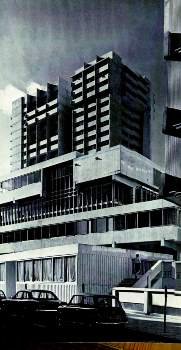
Luxborough Tower, a fine example of 20th century architecture, was proposed in 1965 on the site of the old Marylebone Workhouse. It was designed by the architects’ department of the London County Council and strongly influenced by Le Corbusier. Read a longer account of the architects who designed Luxborough Tower (PDF). Thanks to Alex Reid for this post.
4 – ‘The forms of architecture dominate’
An account of the history of the Polytechnic next door (now the University of Westminster) says that their new Marylebone Road building was completed, after considerable delays, in 1970. There was an opening ceremony with Lord Hailsham in 1971.
The Architectural Review for January 1971 has a long article about the national programme for building new Polytechnics, focusing on the exciting contemporary architecture of our neighbour:
“At the head of the steps from Luxborough Street 'the forms of the architecture dominate'. On the right in the teaching block 'like is grouped with like'. On the left 'all the non-repetitive elements are extracted and ingeniously fitted together in a communal block.”
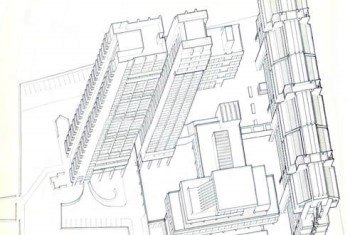
Architectural plans of Luxborough Tower
Archival Image of Luxborough Tower
5 – Moving In
An early resident says, ‘We moved to Luxborough Tower in 1969. It took over a year for the block to get filled with tenants. I remember we thought the sound-proofing was good, but everything else was very basic. I was delighted to have a view of the large red model of Tatlin's Tower next door, displayed on one of the raised mezzanine levels of the Polytechnic.’

Luxborough Tower

View of London from Luxborough Tower
Please get in touch with any questions.